
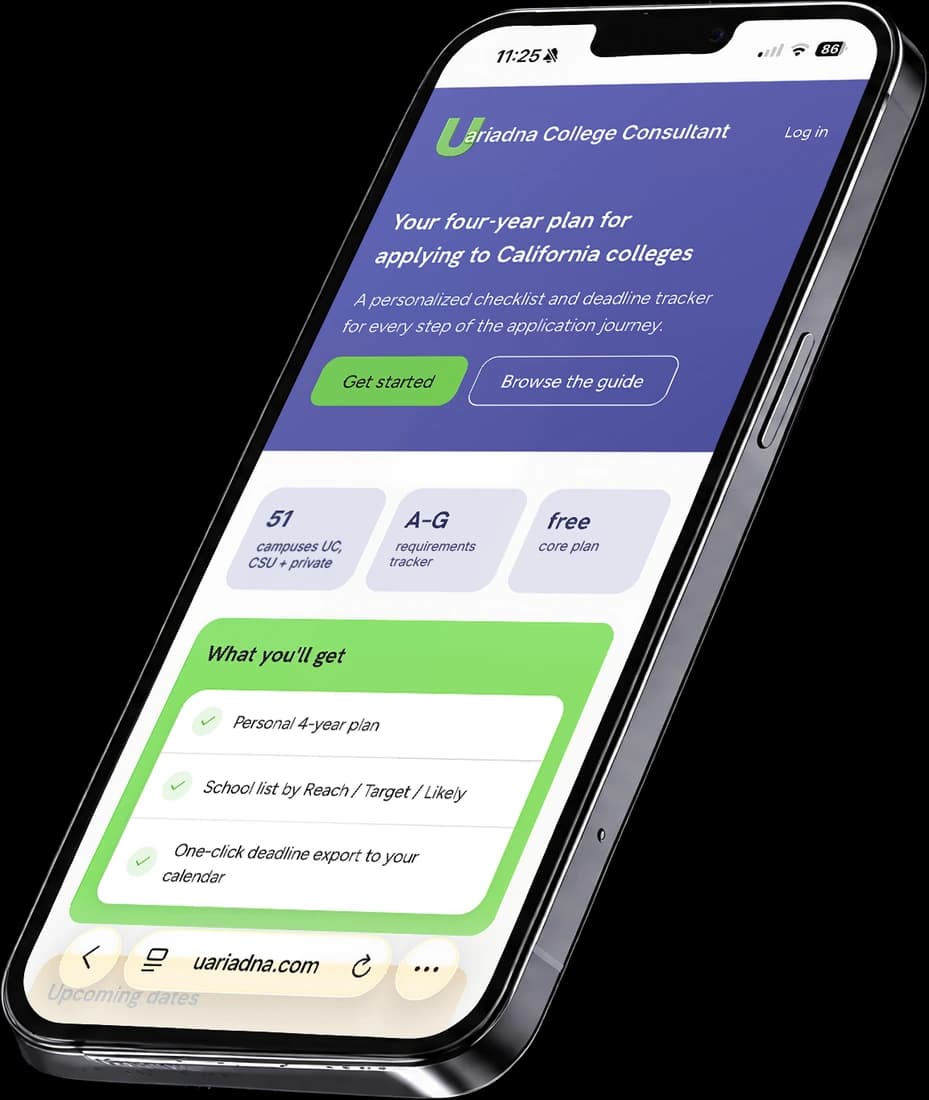
Sign in / Sign upA four-year plan built around your child's grade, a checklist for what to do this month, and the UC, CSU and financial-aid deadlines tracked for you.
None of this is hidden. It is spread across a dozen places that never agree on what matters this month.
They stretch across four years of scheduling. Drop or swap one and it has to be made up somewhere else. Keeping that sum intact is on the family.
Different weighting, different years, different courses. The number at home and the number admissions sees are two numbers.
UC on November 30. Cal State Apply on its own calendar. Each private college on its own — and the dates move between years.
What is actually due this month, and what you can still catch up on. The other three years wait their turn.
The plan puts the A–G check where it belongs in the year, so the course list gets verified while there is still room to change it.
Built from published admit rates and your child's profile, with the source and the admission cycle on every figure.
Put them next to each other and read admit rate, system and programs in one view, instead of keeping six tabs open.
One click sends the dates for your list to Google Calendar or Apple Calendar. Reminders land 30, 14 and 3 days out.
Ask about A–G, GPA or testing policy and get an answer that already knows your child's grade and dates.
You keep the plan. You see what is due, what was missed, and what can still be fixed. Nothing depends on your child remembering to tell you.
Open it on your own phone and see this month. Past years are split into what you can still do and what you cannot, so a late start is a list, not a verdict.
Four questions about your child. The more precise the answers, the closer the college list lands.
Both built for that grade, down to the month.
Reminders at 30, 14 and 3 days. Start late and the plan rebuilds around what is still reachable.
The roadmap marks where your child is right now. Earlier years stay open, and whatever is still reachable in them collects in its own tab.
Make your own planSettle into A–G courses
Confirm your 4-year course plan covers the A–G requirements.
PSAT 10
A low-stakes practice run for the SAT.
Start a real project
Depth beats breadth: one project they own reads better than five clubs.
Submit UC / CSU applications
UC window closes early December — do not wait.
The checklist opens on the current year and shows the count as you go.
The core plan is free. There is no paid tier.
It stays in your account. When you ask the AI consultant a question, part of the profile — your child's first name, grade level, GPA, courses, activities and preferences — is sent to our AI provider so it can answer. Their surname, their school, and anything you write under “special circumstances” are never sent, and we route only to providers that do not keep or train on what we send. Whatever you type into the chat yourself is sent as you wrote it. Nothing is sold or shared with anyone else. The service runs in the US and is built for families with minors.
Federal IPEDS data, the UC system, and figures published by the colleges. Every number carries its source and its admission cycle — where a cycle is older, the page says so.
No. It gives you the thread: what is due, when, and what is still reachable. Walking it is yours.
No. The plan starts from the grade you are in and folds in whatever is still reachable from the years behind you.